
Introduction
It is seven in the evening. The school bag lies open on the floor. Homework is half done. Your child looks up and says, “I don’t know how to do this.” You sit down. You explain the whole thing. The homework gets finished.
The next evening, the same scene plays again. Many parents are familiar with this situation. It can feel like a chore, but the truth is, it’s more about developing a habit. Kids don’t naturally know how to study on their own – they need guidance. Someone needs to teach them how to do it effectively.
This blog explains why children struggle to study on their own. It then gives insightful practical ideas you can try at home, starting this week.
Why Children Struggle to Study ?
Nobody teaches children how to study . Schools teach subjects. Very few lessons teach the skill of studying.
Psychology professor Daniel Willingham told Edutopia that students often say they figured out their study method alone. Some picked up tips from a friend or a video.
When kids are left to figure things out on their own, they usually pick the simplest way to do something. But more often than not, that’s not the best approach.
Easy methods feel good but work poorly
Rereading a page feels productive. So does highlighting. Willingham compares these methods to doing push-ups on your knees. The child feels busy. But they do not train the brain much.
Rushing through the reading
Teachers see this in class every day. Children hurry to finish a chapter. They want to be done. They skip the slow part where understanding happens.
AI replaces the search
This is a newer problem. Many children now ask an AI tool for the answer. They no longer look for it in the textbook. The answer arrives fast. The skill of finding it never grows.
Distractions are stronger than we think
Having a phone nearby can really hurt a kid’s performance. It’s not even necessary for them to be using it – just having it sitting there on the desk can be a distraction. And it doesn’t take much, either – just a three-second interruption can make a big difference, doubling the number of errors they make on a task that requires focus.This is something that Edutopia has reported on, highlighting the impact that phones can have on a child’s ability to concentrate.
Delayed homework and last-minute cramming
Kids usually get a few days to complete their homework, but a lot of them don’t start working on it until the last minute. They think they have plenty of time, so they put it off. Then, when the deadline is near, they rush to finish it all in one night. This is called cramming, and it’s really not a good way to do homework. It makes kids tired and stressed out, and they often forget what they learned soon after.
Other common mistakes
- Children memorise answers without understanding the basics.
- They finish homework only to be done with it.
- They skip revision until the test is near.
- They do not recheck their work.
- They wait for instructions instead of trying the question first.
The good news is straightforward – there’s a solution to each of these issues.
10 Ways to Build Good Study Habits in Children
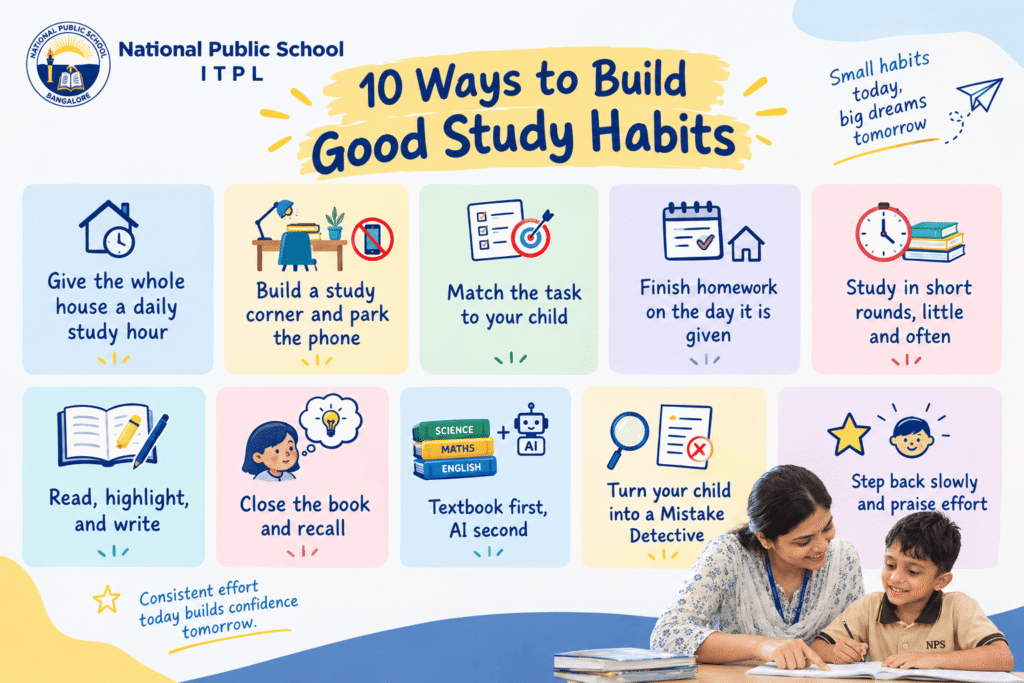
1. Give the whole house a daily study hour
Set aside one special hour every day, at the same time, just for studying. This helps kids know what to expect and gets them into a routine.
Instead of wondering if they’ll study that day, they’ll start thinking about what they’ll be learning during that hour. It’s like having a special daily appointment with their books and it makes a big difference. By doing it at the same time each day, you’re sending a clear message that this hour is important and it’s time to focus on learning.
Take a glance around your child’s study space. What’s catching their attention? Is the TV blaring in the background? Is someone chatting away on their phone? Or maybe a parent is scrolling mindlessly through social media?
Kids are notorious for mimicking what they see, so it’s essential to set the right example. By keeping the house quiet and peaceful during study hour, you’re showing your child that learning is a priority. This simple act can speak volumes and help them develop good study habits. Make it a family hour. Parents can read a book or pay bills. The phone stays down.
2. Build a study corner and park the phone
Choose one spot for studying. It should be quiet, well lit, and comfortable. Keep games and television out of view. Try something simple: create a little pre-study ritual. Put a basket by the door and have your kid put their phone in it before they start studying. Make sure it’s on silent mode, so they’re not tempted to check it.
Dr. Jennifer Katzenstein from Johns Hopkins All Children’s Hospital recommends keeping the phone out of reach, like across the room. Then, when it’s time for a short break, they can have their phone back as a reward for staying focused.
Some kids find that listening to soft music while they study really helps them focus. According to Dr. Katzenstein, it’s okay to try it out and see if it works for your child. Just keep an eye on how they’re doing for about a week. If you notice their work starting to suffer, it’s probably a good idea to turn the music off.
3. Match the task to your child
Every child learns in a different way. Some love reading. Others like writing more. A good first step is to notice which one your child enjoys. Then shape the task around it.
- If your child dislikes reading: Do not ask for the whole chapter. Ask for two pages. Then ask your child to write what they learned.
- If your child dislikes writing: Ask them to read a page aloud. Then ask them to tell you the main idea.
- If your child has trouble paying attention: Try adding a fun, hands-on activity to their lessons. For example, you can use coins or beads to help them understand math concepts better. Or, create a treasure hunt with word cards to make spelling more engaging and exciting. This can help keep them focused and interested in what they’re learning.
When your child is feeling overwhelmed, try using the Two-Minute Start. Simply say, “Let’s just do the first question, and then you can stop if you want to.” The truth is, getting started is usually the toughest part. But here’s the thing: most kids will keep going once they’ve begun.
Small wins build confidence. Slowly, the two pages become four. Then the full chapter feels easy.
4. Finish homework on the day it is given
Teachers often give two or three days for homework. That time is meant for flexibility. It is not meant for delay. Build a simple rule at home. Homework is finished on the same day it is given. The child can polish it on the next day if needed. This one rule changes behaviour. The child learns to act early.
Procrastination loses its grip. Weekend stress drops as well. Letting your kid check off each task they complete on a list can be a great motivator. There’s something about physically ticking a box that makes them feel like they’ve really accomplished something, and it helps keep them excited about staying on track with their habits.
5. Study in short rounds, little and often
No child can focus for hours. Break study time into rounds. One way to help kids stay focused is by using the Pomodoro Technique. Here’s how it works: the child works on a task for 25 minutes, then takes a break for five to ten minutes. For younger kids, you can start with shorter work periods, like 10 to 15 minutes.
Using a kitchen timer can make it feel like a fun challenge, where they’re racing against the clock to get their work done before the timer goes off.
A 2021 brain-scan study reported by Edutopia showed that the brain keeps replaying new practice during rest. Spread learning across days too. Edutopia reports a study where middle school students practised maths problems over three weeks. They scored 21 percentage points higher than students who did the same problems in one sitting.
To help your child really learn something new, try this simple trick: review it with them a few times after the first lesson. The next day, take a few minutes to go over it again. Then, do it again on the third day. Finally, review it one more time on the seventh day. Each time you review, it only takes about five to ten minutes. This can really help your child remember what they learned.
6. Read, highlight, and write
Textbooks are the base of learning. Teach your child a three-step routine.
- Read the lesson slowly from the textbook.
- Highlight the key terms and important lines.
- Put what you’ve read into your own words and jot down some brief notes.
Highlighting has a clear use. Key terms stand out when the child opens the notebook before a test. A last-minute revision becomes quick and calm. Just highlighting something isn’t enough, it can actually make you think you’re learning more than you really are.
The real learning happens when you write things down in your own words. That’s how you can tell if you really understand something – if you can put it into your own words, then it’s sunk in.
Notes that you’ve written yourself are way more useful than just highlighted text, because they show that you’ve actually thought about what you’re trying to learn. Dr. Katzenstein adds that the brain encodes information better when notes are handwritten than when they are typed.
Add one more habit. Look up every new word in a dictionary. Write the meaning in the margin.
7. Close the book and recall
After reading a lesson, ask your child to close the book. Then ask for a brain dump. The child tells you, or writes down, everything they remember. Next, they open the book and check what was missed.
Using a technique called active recall can really help kids learn. For example, a study on third-grade students found that when they answered practice questions after reading something, they did way better than kids who just read the material twice – we’re talking 34 percentage points better. This shows that actively recalling what they’ve learned, rather than just re-reading it, can make a big difference in how well they understand and remember the information.
Using flashcards can be a really helpful way to learn. Some research from Edutopia found that when kids use flashcards, they should keep trying until they get the answer right four or five times. This can actually help them remember things better – by about 40 percent. It’s a simple trick, but it can make a big difference in how well they retain information.
8. Textbook first, AI second
Artificial intelligence tools are now a part of our lives, and it’s not about getting rid of them. What we need to focus on is using them in a way that makes sense. Use the “Three Before Me” rule. When your child says, “I don’t know,” they try three things first.
- Read the question again.
- Look for the answer in your textbook or class notes.
- Think about what the teacher taught on this topic.
The child usually doesn’t ask for help from AI or a parent unless they’re really stuck. And even when they do, they often just want to confirm if their answer is correct, rather than getting the answer handed to them.
Students can ask a chatbot to quiz them. They can also ask it to probe gaps in their understanding. The child stays in charge of the thinking.
Parents can ask two helpful questions. ” What do you understand from the question?” ” What did your teacher teach you about this?” Most children find at least part of the answer. They also learn that they can work things out alone.
9.Turn your child into a Mistake Detective
Careless errors cost marks. Children rush, miss a part of the question, or slip in a calculation. Make rechecking a game. Give your child a red pen. Tell them their job is to catch the mistakes before anyone else does.
A short checklist helps.
- Did I answer every part of the question?
- Are the calculations correct?
- Is the spelling correct?
- Does my answer make sense?
Praise the catch. ” You found your own error. That is a real skill.” Mistakes then feel less scary.
10. Step back slowly and praise effort
Children need less help as they grow. Parents can begin to step back once the child understands the routine. The child should also be able to start a task alone.
In Grades I and II, children still need supervision. Parents need not sit beside them for every minute. Sit nearby at the start. Check the work at the end.
Give small responsibilities along the way. Let the child pack the school bag. Let them read the timetable. Let them choose which subject to start with. If a child cannot finish a task alone, note the exact difficulty. Share it with the teacher. Please avoid teaching a different method at home. It can confuse the child.
When it comes to praising kids, being specific is key. Instead of just saying “good job,” try to be more detailed, like “I can see you worked really hard on that math problem for ten whole minutes!” This kind of praise is way more effective.
Why Parents Believe in NPS ITPL’s Approach to Study Habits?
Tips work better when the school backs them up. This is where our NPS ITPL classroom and the home meet.
Our teachers encourage students to ask in class and clear their doubts on the same day. A small doubt stays small. Left alone, it grows into a gap before the test.
Practice goes beyond the textbook. In Mathematics and Science, students solve examples and questions from reference books. Regular practice builds speed and confidence.
Ideas are tied to real life. Teachers use storytelling and everyday examples to explain concepts. A child who can retell a lesson as a story has understood it.
The Almanac keeps parents informed. It carries messages from teachers. A quick daily look shows what is expected and whether work is going in on time. If a child keeps struggling with one task, parents can note the exact trouble spot. Teachers then follow up with support.
Projects are planned early. We ask parents to avoid last-minute requests for projects and activities. Children gather information on their own, and parents guide them.
Sincere effort gets noticed. Teachers appreciate care and accuracy. That praise pushes children to work with more confidence.
Habits take root at home. The classroom gives them shape. When teachers and parents work as one team, children learn to study with confidence. That is what a best CBSE school should offer.As one of the best National Public Schools in Bangalore, NPS ITPL delivers good academic results. Those results come from an approach that builds study habits early.
Looking for the best CBSE school for your child? Apply for admission here.
Research Sources